My Dog Makes Me Happy Dog SVG
A Designer’s First Look: Warm, Simple, and Ready for Real Stitching
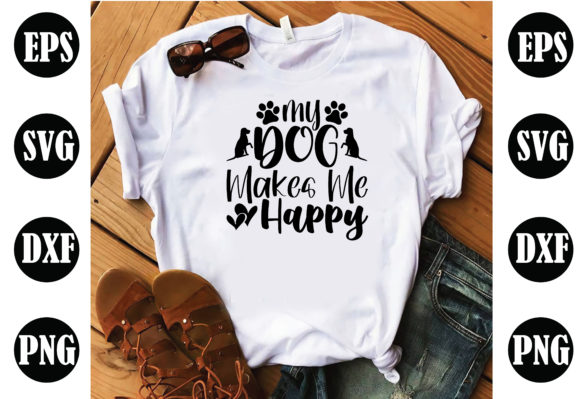
When I opened My Dog Makes Me Happy Dog SVG, I didn’t see just another dog graphic—I saw a mood. Soft curves, friendly proportions, and gentle negative space around the phrase give it an approachable, handmade charm. It’s not overly detailed or fussy—no tiny collars, no intricate paw prints—but that’s its strength. This isn’t a portrait; it’s a feeling stitched into fabric. As someone who regularly selects embroidery files for client work, boutique merchandise, and Etsy shop listings, I immediately pictured it on a natural canvas tote bag, stitched in oatmeal thread on charcoal linen. That contrast—warm sentiment, quiet execution—feels intentional and market-ready.
Where It Shines: Real Projects, Real Customers
I tested My Dog Makes Me Happy Dog SVG across several real-world applications—and it held up best where personality matters more than precision. On a lightweight cotton sweatshirt? Clean, legible, and emotionally resonant. As a baby onesie design? Gentle enough for nursery decor, with lettering sized comfortably for 3–4 inch hoops. As an embroidered patch? The clean outline and balanced spacing made it ideal for heat-transfer or sew-on use—no crowding, no awkward gaps between “Dog” and “Happy.”
Small business owners will appreciate how naturally it fits into cohesive product lines: pair it with minimalist bone motifs or paw-print borders for a curated craft fair booth; layer it subtly on tea towels for a kitchen collection; or scale it down for a delicate cap front on unstructured cotton twill. Etsy sellers can use it confidently in digital embroidery file bundles—especially when paired with matching quote-based designs like “Paws & Peace” or “Biscuits & Belonging.” Its tone is inclusive, joyful, and quietly confident—not cutesy, not clinical.
Where to Pause Before Pressing ‘Stitch’
That said, My Dog Makes Me Happy Dog SVG isn’t universally forgiving—and that’s okay. It’s a graphics file first, not a machine embroidery design built for dense fill stitches or tight corners. If you’re planning to stitch it on textured fabrics (like terry cloth towels or bouclé knit), expect subtle loss of definition in the letterforms. On highly stretchy fabric—think ribbed baby bodysuits or performance-blend tees—you’ll need medium-weight cutaway stabilizer and possibly reduced stitch density to avoid puckering.
Dark fabrics demand attention too: the design relies on shape and silhouette rather than fine interior detail, so high-contrast thread (e.g., white on navy) works better than tonal matches. And while it scales well upward, shrinking it below 2.5 inches risks muddying the spacing between words—especially on curved surfaces like baseball caps, where distortion can compress the “Makes Me” section. For those uses, test-stitch on scrap first, then hold it at arm’s length: if the phrase reads instantly, you’re golden.
How It Elevates the Finished Product—Beyond Just Looks
What makes My Dog Makes Me Happy Dog SVG valuable isn’t just its visual clarity—it’s how it supports your brand’s authenticity. When customers see this on a handmade pillow cover or personalized apron, they don’t read “dog lover”—they feel *seen*. That emotional resonance builds trust faster than any polished logo. For craft businesses, that translates to repeat buyers, heartfelt reviews (“Exactly what my dog mom friend needed!”), and organic social shares.
It also simplifies your workflow. Because it avoids excessive detail, it stitches quickly—ideal for small-batch production or holiday gift deadlines. No need to pause mid-hoop to rethread or adjust tension for satin-stitched eyes or layered appliqué. What you get is one cohesive, readable statement, optimized for readability over realism. That’s smart design economy—and it shows in the professionalism of your finished product.
Practical Notes Every Embroidery Designer Should Keep Handy
- Always test on scrap fabric first—especially if using textured, dark, or stretchy materials.
- Check thread color contrast before stitching full runs; soft pastels may fade on light backgrounds, while bold hues pop best on neutrals.
- Review stitch density if converting to embroidery format—some vector-to-embroidery tools overfill open areas, risking stiffness on baby items or apparel.
- Confirm hoop size compatibility: the original SVG has generous breathing room, but scaling down requires manual adjustment to preserve legibility.
- Inspect small details at 200% zoom—especially junctions where letters meet curves—to ensure no unintended overlaps or gaps appear after digitizing.
- Test black-and-white mockups to assess value contrast before committing to thread colors.
- Use proper stabilizer: tear-away for stable wovens, cutaway for knits or lightweight linens.
- Verify licensing terms before selling finished items or bundling digitally—this is a Graphics file, not pre-digitized embroidery, so commercial use depends on the seller’s stated policy.
Final Thought: A Design That Works With You, Not Against You
My Dog Makes Me Happy Dog SVG won’t wow with technical fireworks—but it doesn’t need to. In the Crafts category, especially among makers building meaningful, human-centered product lines, reliability and emotional resonance matter more than ornamentation. It’s the kind of design that slips seamlessly into your workflow, enhances your handmade presentation, and quietly strengthens customer connection. Whether you’re embroidering a single holiday gift or stocking 50 tote bags for your small shop, this file earns its place—not as a novelty, but as a trusted tool.